Fatteh Adas during genocide
From the West Bank, Lama Obeid shares a lyrical recipe for the Palestinian dish Fatteh Adas against the backdrop of the genocide
By Lama Obeid
Commissioned by Molly Lipson
Most days we feel helpless while trying to remain hopeful. We watch as Israelis attack food aid trucks at the Karam Abu Salem border. We watch them stomp on the food, making it inedible. We watch them show their children how to do the same. Meanwhile, our children, the children of Gaza, are dying of famine imposed by the Israeli siege. Our children lick empty pots, collect specks of flour from the ground, and eat bread made from animal feed. Parents risk their lives by venturing out to look for food – they are easy targets for the occupation forces.
We remind ourselves that our people have survived several attempts of ethnic cleansing and yet we still exist, 76 years and yet we still have a Palestinian identity in The Gaza Strip, in The West Bank, in Historical Palestine, in the diaspora.
After watching the violence on loop all day, our stomachs begin gurgling, reminding us that we are hungry. We go into the kitchen where we find stale bread and decide to toss it out. But then we remember the famine in Gaza, we remember when our families were forced to depend on UN rations in 1948, and we decide to draw on the wisdom of our Palestinian mothers, grandmothers and ancestors. We begin to prepare dinner.
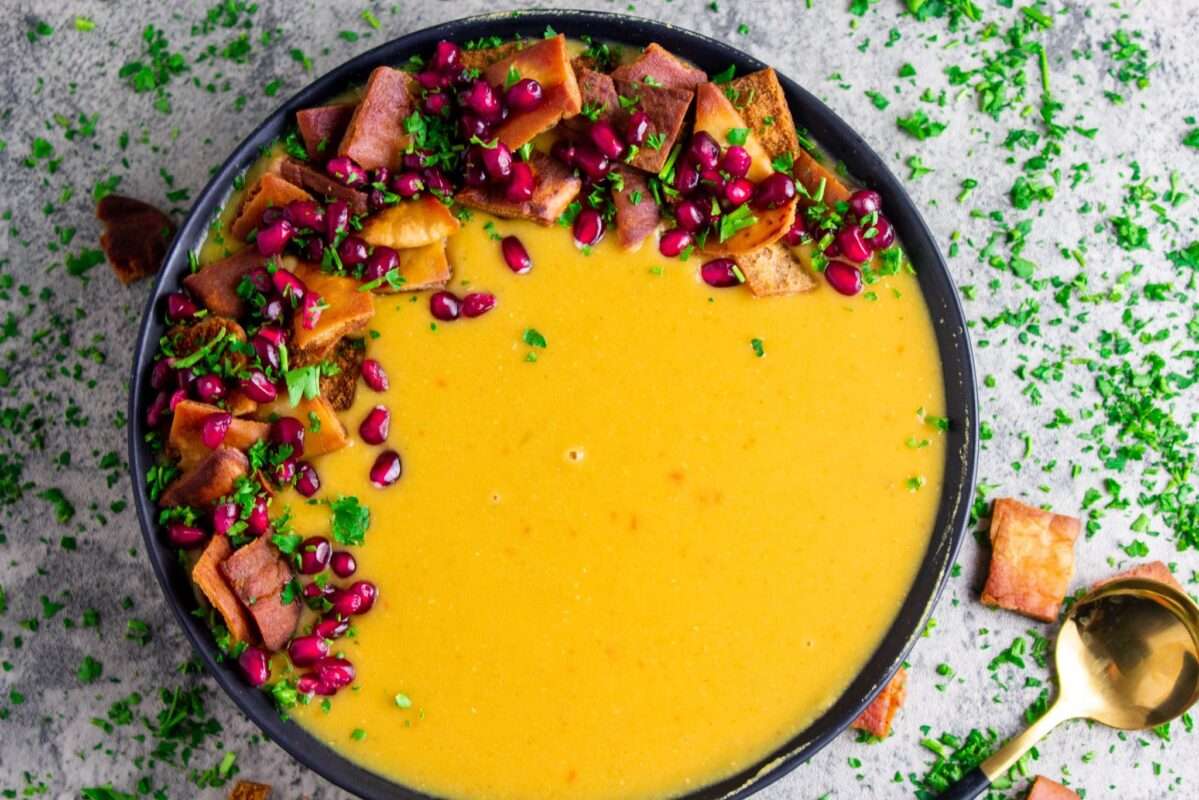
The sweetness of the caramelised onions; the warmth of the cumin; the richness of the lentils; and the stale bread that becomes soft and mushy as it absorbs the soupy liquid. The acidity of the freshly-picked lemon squeezed on top and the crunchiness of the spring onion. These aromas, textures and flavours make up Fatteh Adas, a filling and nutritious Palestinian comfort food. This is what we decide to make.
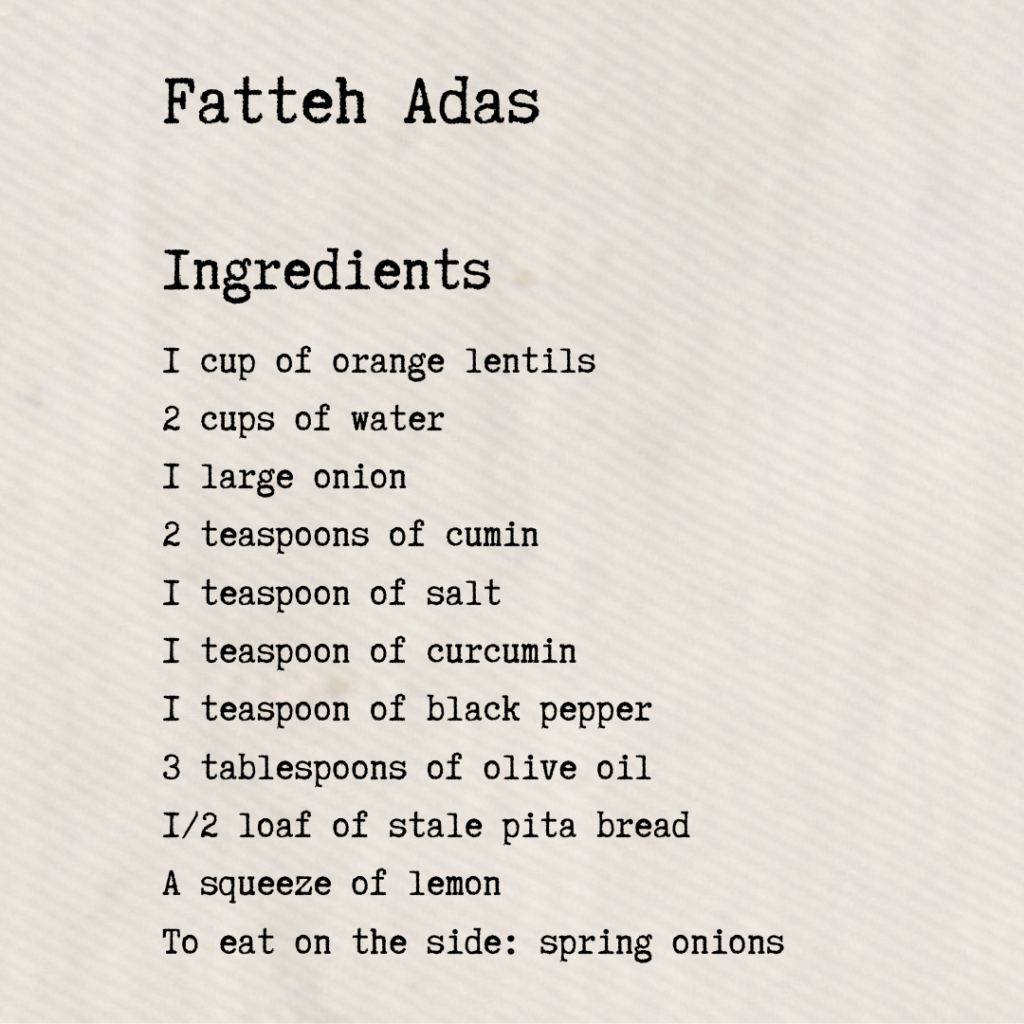
- We pull out a Pyrex dish, or as our parents and grandparents pronounce it, ‘Byrex’ as the Arabic language does not have a ‘P’ (which is why we began boycotting ‘Bebsi’ and ‘Bambers’ at the start of the genocide).
- We take the stale bread and begin breaking morsels into the ‘Byrex’ dish with our hands.
- We then take out a large tin pot. It once belonged to our grandmother who used it to cook over a fire for her large families. The aroma would penetrate the tents in the refugee camp and the children would wake up and rush to help speed up the process. The pot is uneven at the sides and black from years of cooking on the fire but it is perfectly Palestinian and the best to make Shuwrabat Adas – lentil soup – in.
- Into a hand-painted mug with blue flowers we got from our last visit to the pottery shop in Hebron, we measure out one mug of orange lentils and pour it into our grandmother’s tin pot.
- We measure out two mugs of water and pour them into the pot and turn on the stove. We leave it to simmer for 30 minutes.
- While the lentils are cooking, we take out a large onion from a basket in which our grandfather used to collect his fresh groceries from the market.
- Into a frying pan we pour a generous amount of olive oil from our tanaka that we ordered from Palestine because the olive oil overseas just doesn’t taste the same.
- We slice the onions and add them to the pan, along with some cumin to help with bloating, and begin stirring the onions until they are crispy.
- After 30 minutes, our lentils are boiling and have turned into a yellowish colour. We add salt, pepper, curcumin and cumin, and turn off the stove.
- We take a hand blender to the lentils until they become a thick mixture.
- While it is still hot, we begin scooping the soup with a ladle and pouring it onto our stale bread in the ‘Byrex’ dish. We continuously soak the bread with the adas until it can no longer absorb more.
- We then cover the ‘Byrex’ dish for five to ten minutes and wait for the flavours of the soup to fully seep into the bread.
- We go out to our garden and pull out a few spring onions that we wash and put into a dish to crunch on during the meal. (You can buy these from a grocery shop if you don’t grow your own.)
- We run to aunt Nadia’s house which is a block away and pick two lemons from her tree which she grew from seeds she got from her lemons in Palestine. Aunt Nadia sticks her head out of the window and yells, “Stop stealing my lemons!” We yell back, “We will send you Fatteh Adas in return,” and run back home. (You can also buy lemons from the shop.)
- We then go into the pantry and to get some olives that our parents brought back with them from their last olive harvest in Palestine. We take the pan of caramelised onions and pour it onto the soaked bread and lentil soup mixture in the tin pot.
Before we begin to eat, we take out a tupperware or as aunt Nadia says, ‘tubberware’. We run back to her house with the ‘tubberware’, place it on the doorstep, ring the bell and begin running back, because the joy of Fatteh Adas is eating it hot. Aunt Nadia yells from her doorstep: “I hope you got the recipe right this time!” Finally, we are reunited with our Addas. We take a large circular tin sidr – a Palestinian tray – and place our Fatteh Adas on it, surrounded by our olives, spring onions, and lemons to squeeze onto our Adas before we eat. We do not want to squeeze the lemons too early or the “vitamin C will be absorbed into the air,” as our parents often warned us. We take the sidr and go back to the living room to watch the news and we weep over our meal as we watch the children of Gaza eating a stale piece of bread with no Shuwarabat Adas to soften it.
–
Lama Obeid is a Palestinian writer and trainer based in Ramallah, Palestine. She writes about culture, gastronomy, politics, and travel. She advocates for the Palestinian cause wherever she goes and is a third generation Palestinian refugee displaced from the town of Ein Karem in West Jerusalem.